Bloat Information
Gastric dilatation-volvulus (GDV) syndrome is a life threatening
condition that is most common in large, deep chested dogs such
as Great Danes, Saint Bernards, Irish Setters and German
Shepherds to name a few. Although GDV usually occurs in adult
animals, there have been cases reported in puppies as young as
three months old. The most recent statistics are that 43% of
Danes will bloat at sometime in their life. In puppies, gastric
dilation without torsion (commonly referred to as BLOAT) is
often caused by overeating. Such dilation can be relieved by
vomiting. Torsion or volvulus occurs when the stomach dilates
(bloats) and begins to rotate on its long axis. GDV causes
severe hypovolemic (circulatory) shock. Patient survival depends
on aggressive and immediate therapy and surgery. Management
involves treatment of shock, gastric decompression and surgery.
The objectives of surgery are to reposition the stomach, to
evaluate the condition of internal organs for possible dead
tissue and the surgical procedure that will prevent recurrence.
From the onset of clinical signs, every minute counts for the
dog’s survival. You can not wait on getting veterinary care!
Surgery performed will save the dog’s life if done quickly; it
is an emergency procedure. However, many owners of such prone
breeds elect to have a prophylactic surgery at an early age that
will prevent the onset of GDV. There are many theories and
plenty of research studies about what causes GDV and Bloat. At
this time, the actual cause is not known.
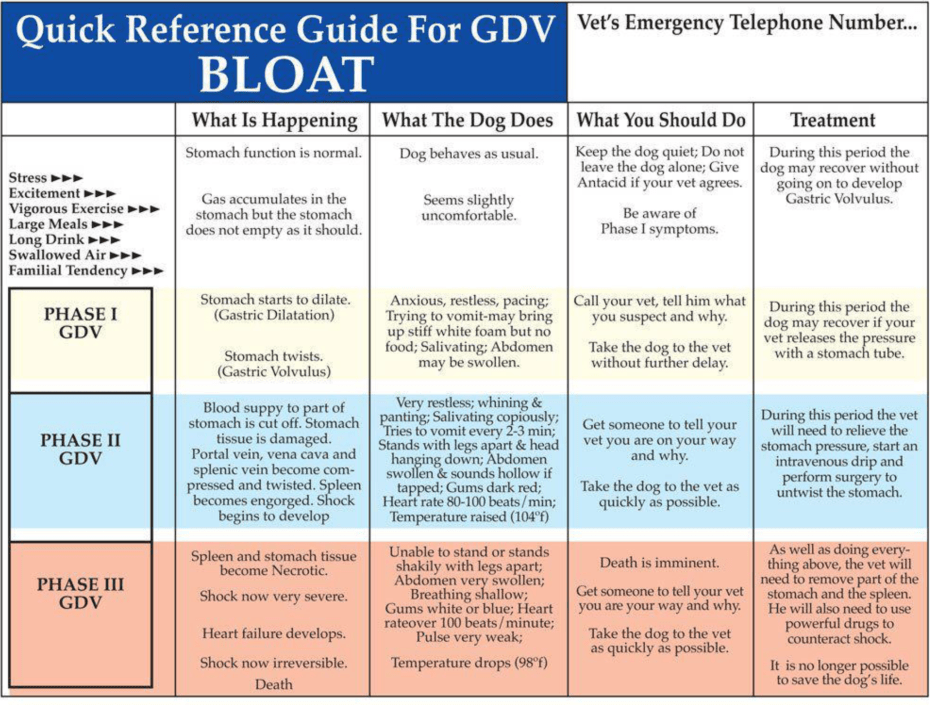
CLINICAL SIGNS Abdominal pain and distention A tight,
full abdomen (when tapped with finger sounds drum like) Drooling
(usually not clear in color, but filled with bubbles appearing
almost white, like runny shaving cream) Restlessness, not
comfortable laying down Non productive vomiting, retching
without passing anything As GDV advances, the animal will
sometimes stand with its head lowered and legs somewhat out from
under it to the sides Signs of hypovolemic (circulatory) shock
can be present. They include pale mucous membranes (gums);
rapid, shallow respiration; a weak, thready pulse; rapid
heartbeat. There may also be a prolonged capillary refill time
and you can check this by pressing a finger to the gum,
releasing and watching to see how quickly the gum becomes pink
again (normally, it should be immediately).
SUGGESTIONS TO TRY TO AVOID GDV Feed two meals a day
instead of one large one Feed and water from an elevated bowl
(dog’s shoulder height) Do not allow vigorous exercise
immediately before of after meals Do not allow the dog to drink
excessive amounts of water right after vigorous exercise or
immediately before of after a meal An animal under stress is
particularly subject to GDV (as well as many other illnesses).
You must be aware of your animal’s eating habits, exercise
patterns and normal behavior so you can tell immediately if
something is not right, specially in a stressful situation.
GASTRIC DILATATION VOLVULUS IS A LIFE THREATENING CONDITION.
IT IS IMPERATIVE THAT YOU SEEK IMMEDIATE VETERINARY HELP IF YOUR
DOG EXHIBITS ANY OR ALL OF THESE SYMPTOMS!!!